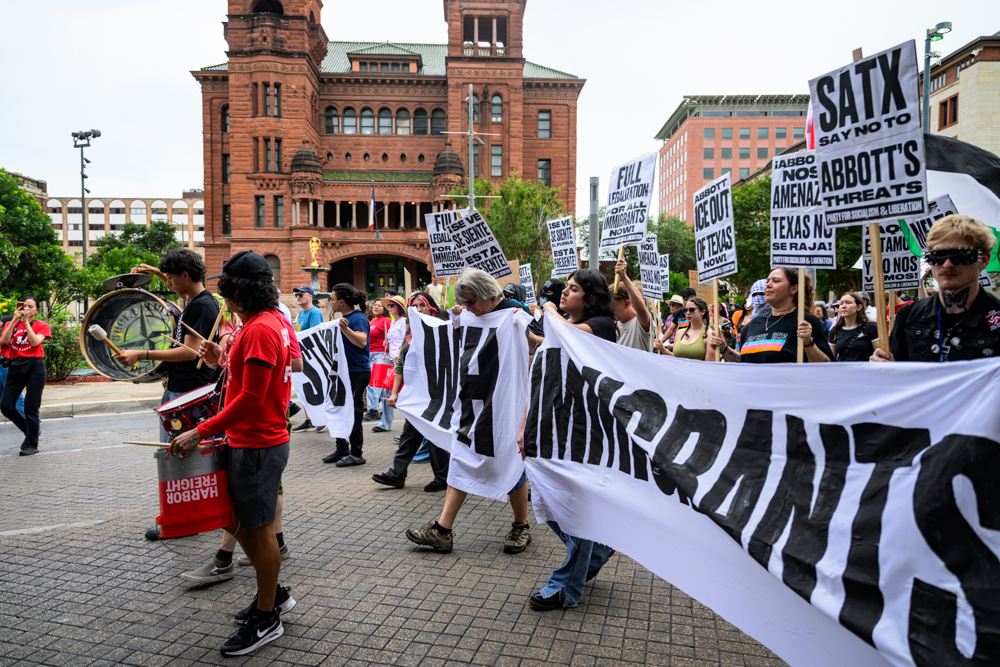



Audio system on the San Antonio-based Mexican American Civil Rights Institute’s 2026 Symposium this weekend urged the viewers to boost their voices and converse fact amid the Trump administration’s immigration crackdown.
The occasion, held at downtown’s Malú & Carlos Alvarez Theater, convened students, organizers, artists and policymakers to debate the state of civil liberties and the evolving identification of Mexican People. The 2-day gathering featured speeches on Saturday by Carmen Perez-Jordan and Rochelle Garza, two of the nation’s most influential Latina civil rights leaders.
Perez-Jordan, a human rights activist and co-chair of the 2017 Ladies’s March, opened the day’s programming with an tackle grounding the viewers in a imaginative and prescient of ancestral reminiscence. She argued that civil rights work should begin with an understanding of the origins of our communities.
“Reminiscence tells us who we’re,” Perez-Jordan mentioned. “Reminiscence reminds us the place we come from. … We belong to a folks, to a legacy, to a narrative.”
The activist additionally challenged narratives that forged Mexican People, who signify greater than 11% of the overall U.S. inhabitants, as outsiders.
“Earlier than there was a border, we had been right here,” Perez-Jordan mentioned. “Earlier than our tales had been politicized, criminalized, distorted and erased, we had been right here.”
Perez-Jordan additionally spoke concerning the private loss that propelled her into activism. She defined that after her sister’s dying when she was a young person, she discovered that “silence has penalties.” She urged attendees to cease ready for permission to guide.
“I consider this nation remains to be unfinished. I consider democracy remains to be being written, and I consider each era has a duty to put in writing the that means of freedom,” she mentioned.
For the reason that historic 2017 Ladies’s March, Perez-Jordan has traveled the nation asking communities what they might insist upon if the nation’s founding promise had been being written right now. From these conversations, she mentioned, a typical thread emerged.
“Independence will not be sufficient. We’d like interdependence. We’d like a rustic the place our freedom is tied to 1 one other’s freedom. … Our humanity is tied to everybody’s humanity,” she mentioned. “As a result of none of our liberation is separate.”
Perez-Jordan’s remarks had been adopted by a keynote by Rochelle Garza, the chair of the U.S. Fee on Civil Rights and president of the Texas Civil Rights Undertaking. She mentioned that her highway to social justice work began at residence, along with her brother Robbie, who confronted discrimination due to his disabilities.
“ I discovered sadly, at a really younger age, that there are folks in positions of energy who will take a look at somebody like my brother and determine that it’s simply not definitely worth the time to deal with them like an individual,” she mentioned.
Garza linked that non-public historical past to a broader sample of exclusion Mexican People face.
“Civil rights aren’t summary,” Garza mentioned. “They’re about whether or not we, the folks, enable these in energy to determine who deserves dignity, who has the appropriate to safety beneath the regulation, and finally, who will get to be handled as totally human.”
From there, Garza delivered a sweeping historic indictment. She traced the historical past U.S. immigration enforcement from the Mexican Repatriation between 1929 and 1939 to Operation Wetback in 1954 to right now’s interior-enforcement machine. She additionally detailed the trendy instruments of exclusion, which have grown to accommodate facial recognition expertise, license-plate monitoring, AI-driven surveillance and collaboration between police and Immigration and Customs Enforcement (ICE).
“We should always all assume that our day by day actions are being watched,” she warned, citing a 2024 U.S. Fee on Civil Rights report discovering “no current safeguards” on federal use of facial recognition.
The guts of Garza’s keynote was the political energy of truth-telling. In her position on the Civil Rights Fee, Garza has moderated the Folks’s Hearings on Immigration Enforcement, the place communities have created their very own public report of racial profiling, ICE violence and disappearances.
“Throughout occasions of common deceit, telling the reality turns into a revolutionary act,” she mentioned. “Each story handed down from era to era, each corrido, information article and courtroom case — we’ve been documenting and talking fact to energy, regardless of the consequence.”
Her evaluation of the state of Mexican American civil rights added to Perez-Jordan’s judgment that “independence will not be sufficient.” Garza sharpened that concept right into a mandate that interdependence requires fact, and fact requires braveness.
Collectively, the 2 leaders left the viewers with the cost that in a second of nationwide deceit, telling the reality will not be solely a radical act of resistance, but additionally our path to liberation.
Signal Up for SA Present newsletters.
Comply with us: Apple Information | Google Information | NewsBreak | Reddit | Instagram | Fb | Twitter | Or join our RSS Feed
Associated Tales

Abbott, an unrepentant Trump ally, threatened to withhold funding from Texas cities that cross insurance policies limiting police cooperation with ICE.

Minnesota prosecutors say the agent lied about what led as much as the capturing. He’s now charged with 4 felonies and one misdemeanor.

A U.S. choose on Thursday granted a preliminary injunction towards important sections of Senate Invoice 4, however a provision permitting police to arrest folks suspected of unlawful entry did activate.